Delhi Metro Hits 80.54 Lakh Boardings, Near Record
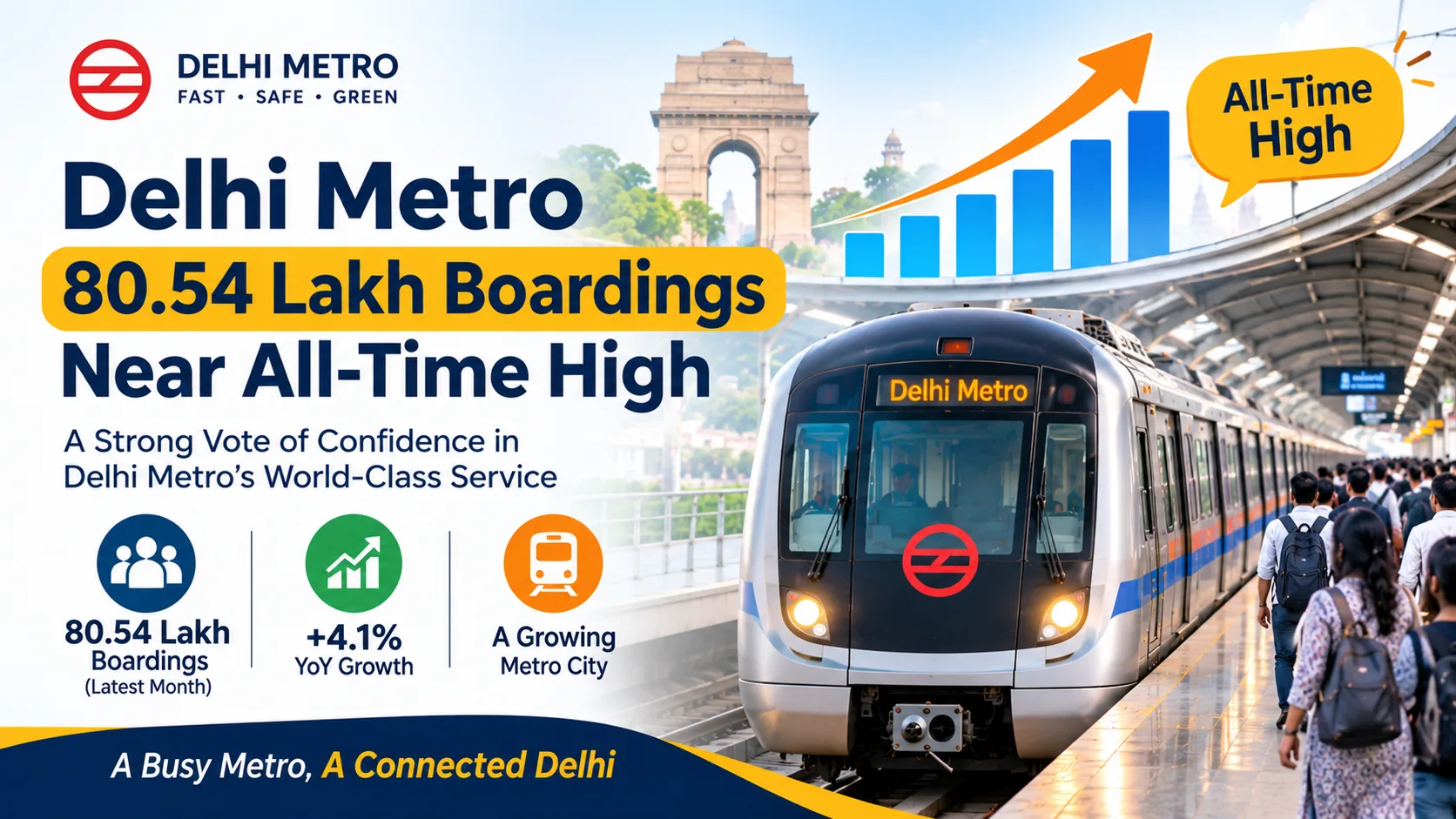
Delhi's metro network came close to its busiest day on record at the start of November, as pollution-control measures and fresh restrictions on some vehicles pushed more commuters onto trains. According to Metro Rail News, the Delhi Metro logged 80.54 lakh passenger boardings on Monday, 2 November 2026. The figure is about 1.9 lakh short of the system's all-time high.
The surge prompted the Delhi Metro Rail Corporation (DMRC) to run additional train trips and deploy extra facilitation at stations to manage peak-hour crowds.
Ridership Climbs Past 80 Lakh#
The 2 November count marks one of the strongest days in the network's operating history. Metro Rail News reports that the record still belongs to 1 September 2026, when the system handled 82.44 lakh boardings.
The comparison with the previous week is striking. On the preceding Monday, the network recorded 72.24 lakh boardings. That puts the week-on-week rise at roughly 8.3 lakh boardings, an increase of a little over 11 per cent based on the reported numbers.
Key figures reported by Metro Rail News:
- 80.54 lakh boardings on Monday, 2 November 2026
- 82.44 lakh boardings on 1 September 2026, the current all-time record
- 72.24 lakh boardings on the previous Monday
- About 8.3 lakh more boardings than the previous Monday
- 374.5 km network length across 271 stations
- About 26.4% of boardings each on the Yellow Line and the Blue Line
What Drove the Jump#
Metro Rail News attributes the spike to two linked developments. The first is a set of new curbs on certain vehicles registered outside Delhi. The second is a round of pollution-related restrictions under the Graded Response Action Plan (GRAP).
Together, these measures appear to have made road travel less convenient or less permissible for some commuters, who then turned to the metro. The report does not specify which categories of outside-registered vehicles were affected, which GRAP stage was in force, or when the restrictions took effect. Those details will be important for judging how long the elevated ridership may last.
How DMRC Responded#
To cope with the additional demand, DMRC added train trips and stepped up facilitation at stations, according to the report. The stated aim was to ease crowding during peak hours.
The material describes the extra services as 20 trips added, with 40 extra trips in total. It does not explain how these two figures relate. They may refer to separate phases of augmentation, to different lines, or to a cumulative count. Until DMRC clarifies, readers should treat the exact scale of the service increase with caution.
The report also does not detail what station facilitation involved. Typical measures could include additional staff, queue management or more ticketing counters, but none of these are confirmed in the source.
A Network Leaning on Two Corridors#
The line-wise breakdown highlights how unevenly demand is spread across the system. Metro Rail News reports that the Yellow Line and the Blue Line each carried about 26.4 per cent of the day's boardings. That means just two corridors accounted for more than half of all boardings on the 374.5-km, 271-station network.
By a simple calculation from the reported share, each of these lines handled roughly 21 lakh boardings on 2 November. This is an estimate derived from the published percentages, not a figure reported directly.
The concentration matters for operations. When ridership jumps sharply, the pressure tends to build on the busiest trunk routes and their interchange stations first. The added trips are therefore likely to matter most where crowding was already heaviest, though the report does not say which lines received the extra services.
Context and Background#
The term boardings, as used in the report, generally counts each time a passenger enters a line. A single trip involving an interchange may be counted more than once. On that basis, boardings usually run higher than the number of unique journeys. The source does not define the metric, so this reading should be confirmed with DMRC.
Pollution-linked restrictions have, in past years, coincided with the onset of winter in the National Capital Region, when air quality tends to worsen. If that pattern holds, metro demand could stay elevated for as long as the curbs remain in place. This is general background rather than a finding of the report.
The September record is also worth noting. The current peak was set roughly two months before this latest surge. The report does not say what drove that earlier high.
What It Means for Riders#
For daily commuters, the immediate effect is likely to be fuller trains and busier stations, particularly at peak hours and on the Yellow and Blue corridors. The additional trips should offer some relief, but the gap between the latest figure and the record suggests the system is operating close to its highest recorded demand.
Riders who usually drive, or who depend on vehicles affected by the new curbs, may need to allow extra time for travel and for interchanges. If ridership keeps climbing, a new all-time record is possible. The current daily figure is within about 1.9 lakh boardings of that mark.
For DMRC, the episode is a test of how quickly the operator can scale services when policy decisions outside its control shift travel patterns overnight.
Conclusion#
The Delhi Metro's 80.54 lakh boardings on 2 November 2026 show how quickly road restrictions can redirect demand to rail. According to Metro Rail News, the count came within reach of the 82.44 lakh record and ran about 8.3 lakh above the previous Monday. DMRC has added trips and station support in response. How long the surge lasts will likely depend on how long the vehicle curbs and GRAP measures stay in force, and on whether the operator can keep adding capacity on its most crowded lines.